
The Saint Anne Pilgrimage Site Near Pohled
In the past, many people made the pilgrimage to Saint Anne near Pohled; it was once the most visited pilgrimage site in the area.
While looking through old photos in a family album, we found many unfamiliar faces—including a great-aunt from Vienna who, until the war, would return home to Havlíčkova Borová every summer for the pilgrimage to Saint Anne near Pohled.
Making a pilgrimage to a site associated with miracles and healing waters—in hopes of having prayers and petitions answered—was primarily a religious undertaking. However, the old folk saying, “Saint Anne brings a chill to the morning,” also highlights the connection between her feast day, the weather, and, consequently, agricultural work in the fields.
“We wish you a good day, Mary; we wish you a good day, Mary—Mother of God, Holy Mother of God—we wish you a good day, Mary.” This is one of the hymns sung by pilgrims as they traveled toward the Church of Saint Anne near Pohled.
Saint Anne and Saint Joachim were the parents of the Virgin Mary. For a long time, they were unable to have children; then, at an advanced age, Anne gave birth to Mary, the mother of Jesus. In Hebrew, the name “Anne” means “gracious” or “full of grace.” In the East, the feast of Saint Anne has been observed since the mid-sixth century, known as the “Dormition of Saint Anne.” It spread to the West in the twelfth century. In Bohemia, she was a highly venerated saint, particularly during the 15th and 16th centuries. In 1481, Pope Sixtus IV introduced the feast of Saint Anne into the Roman calendar. Pope Pius V abolished it in 1568. In 1584, Pope Gregory XIII reintroduced it and set the feast day for July 26. That same year, the feast of Saint Joachim was also added to the Roman calendar. Currently, the commemoration of both parents of the Virgin Mary—Anne and Joachim—is celebrated on July 26.
Saint Anne is the patron saint of marriage, mothers, and safe childbirth, as well as the protector of miners, millers, carpenters, weavers, and tailors. People used to pray to her during thunderstorms, or for rain during periods of drought.
In the 13th century, a Cistercian nunnery was established in Pohled; it was originally called the “Valley of the Blessed Virgin Mary” and later *Frauenthal*—the “Valley of the Maidens.” The architect Jan Blažej Santini was active in this area as well. The nearby pilgrimage site, featuring the Church of Saint Anne, was likely influenced by him; at one time, it was even speculated that his original plans were used for its construction.
The Church of Saint Anne lies nestled beneath a canopy of centuries-old linden trees, encircled by fourteen small chapels that represent the Stations of the Cross. Nearby stands a tall wooden cross, marking the site of a cemetery for victims of the plague of 1772. A new chapel was built in 1824 over a miraculous spring—replacing an earlier one from 1731—where modern-day pilgrims can still refresh themselves with the cool, clear water.
The chronicle of Pohled, written by Mr. Hladík, describes the pilgrimages and the legend surrounding the origin of the Saint Anne pilgrimage site. According to the legend, in 1730, a scribe—who later became the estate manager for the monastery in Pohled—got stuck in the mud in the forest while chasing a wolf. Unable to free himself, and fearing for his life, he began to pray. As he prayed, he heard the sound of an organ and a kind of chorale—a chant unknown to him—rising from the depths; several times, it is said, he heard the invocation, “Saint Mother Anne!” He began to call upon Saint Anne for help, vowing that if he were saved, he would build a small chapel in her honor at the very spot where he managed to free himself from the mire. Gathering new strength and courage, he extricated himself from the perilous place. He fulfilled his vow. While the foundations for the chapel were being dug, a healing spring was discovered, its waters flowing into a small well.
News of his miraculous rescue spread throughout the area; people would come to the small chapel to pray and drink water that tasted different from the water in their own wells. A partially blind woman who washed her eyes with the water found her vision improved, and word of the miraculous water spread further afield. The monastery had a hermitage built nearby, though it later ceased to exist. A hermit kept a record of the miracles that occurred at the spring.
The number of pilgrims grew—first by the tens and hundreds, and later, crowds numbering in the thousands flocked to the miraculous water. The small chapel was no longer sufficient. Pilgrims brought offerings, and when news spread that a church was to be built, local communities contributed funds; construction began in 1760. According to legend, whenever the masons who had dug the foundations and begun building returned the following morning, they would find everything torn down.
This happened three times; the third time, they discovered footprints near the site. They concluded that Saint Anne herself had visited the spot and had designated a location slightly further away for the church. A Baroque church was built on this new site, constructed to the exact dimensions indicated by the footprints.
The church was consecrated in 1761, and two small bells were hung in 1766. Once the church was completed, Masses were held there. Major pilgrimages took place on the Sunday following the Feast of Saint Anne, during the Octave, on the Feast of Saint Joachim, and on the Sunday following the Feast of Saint Wenceslas. Chemical analysis revealed the presence of sulfur, iron, and lead oxide in the water; consequently, in 1858, Count Sylva Taroucca had a spa building constructed in the forest. A pit was excavated near the spring, and wooden pipes were laid to transport the water to the spa building. The water was heated in copper cauldrons, and guests underwent treatments consisting of either coniferous or peat baths. People traveled here for treatment from Jihlava, Znojmo, Prague, and Vienna.
During major pilgrimages, pilgrims from the immediate vicinity would arrive early in the morning and return home by evening. Processions arriving from further afield would set out the day before the pilgrimage and not depart until the third day. Large processions would arrive led by a priest, accompanied by banners and music. Women often carried large bundles or big wicker baskets on their backs, filled with cakes and pastries, which they would give to the cottagers who provided them with lodging for the night.
In Pohled, pilgrims found places to sleep everywhere: in small houses, living rooms, attics, barns, and sheds. Some stayed in the *dupárna*—a covered wooden dance pavilion located near the Chapel of Saint Anne, behind the inn—while others were packed tightly together in isolated dwellings. Some even slept under the trees in the forest. The priests were typically hosted by the local parish priest.
Along the grassy verges on both sides of the road—stretching from the small pond all the way to the forest—sat barrel-organ players, as well as beggars who were blind, or missing limbs. Devout pilgrims tossed alms into their caps. In the forest, there were various attractions: a circus, several carousels, shooting galleries, swings, a sideshow, and more. Along the main path leading to the church, and from the church to the small chapel, gingerbread makers and various peddlers set up their stalls. Beer was served at several locations within the forest.
In the spring of 1887, the small spring ran dry. It was necessary to find a new spring—a task that was ultimately successful—but the water had to be channeled from the old gamekeeper’s lodge to a spot beneath the small chapel; the spring was then walled in all around to prevent the water from carving a new path. The spa building was converted into an inn, and guests would come here for summer stays. Over time, everything changed; many pilgrimage sites disappeared, and even at Saint Anne’s, people now visit during pilgrimages primarily for recreation and entertainment.
Source: *Chronicle of Pohled* by František Hladík
Author: Edita Machová
Published in Czech: http://www.regionvysocina.cz/zpravodajstvi/poutni-misto-svata-anna-u-pohledu/
Pilgrimages to Green Mountain and Saint John of Nepomuk
For several centuries, pilgrims have been heading to Green Mountain near Žďár nad Sázavou, to the pilgrimage church dedicated to Saint John of Nepomuk, which was listed as a UNESCO site in 1994.
In Jaroslava Stránská’s book *Havlíčkova Borová in the Testimony of Old Parchments*, pilgrimages to Green Mountain are mentioned. It talks about a snow calamity in May 1885. “On the night of May 15-16, so much snow fell that the procession couldn’t even go to the chapel of Saint John of Nepomuk under Borová near the brewery, where people went every year. There was a big storm and frost, and the snow stayed on the ground until the next day, the roads were full of snow. In the entire area, so much snow fell that in the schoolyard and elsewhere, drifts were two meters high. Snow remained in many places for a whole week. Near Stržan, two people died in the snowdrifts that night. That year, pilgrims went to Green Mountain by sleigh.”
The pilgrimage church on Green Hill is actually located about an hour on foot, or twenty minutes by car, from Havlíčkova Borová. On the way from Havlíčkova Borová, we encountered lots of mysterious crosses from different times, which seemed to emphasize the sacredness of the path that pilgrims once took to Green Hill. The last one, on the hill above Žďár, marks the spot with a beautiful view of the valley where the town spreads out, with the elevation where the Green Hill pilgrimage site stands. The foundation stone for it was laid on May 16, 1720, and it was already consecrated on September 27, 1722.
It is the work of Abbot Václav Vejmluva and architect Jan Blažej Santini Aichl, the founder of Baroque Gothic. The church’s floor plan is in the shape of a pentagram, that is, a five-pointed star. This protective symbol recalls the stars over the Vltava, which appeared after he was tortured in 1393 and his body was thrown off the Charles Bridge. He supposedly knew the confessional secrets of Queen Sophie. Jan was an educated man and worked as a general vicar at the Prague archbishopric. His death was the result of tense relations between the archbishop and King Wenceslaus IV.
He is co-patron of the Czech lands, also of the Salzburg diocese, and the patron of millers, raftsmen, boatmen, and confessors. He was a protector against floods and the patron of bridges. His statues can be found on bridges, by rivers, streams, and ponds all over Bohemia and beyond. At a bridge, his statue can be found in Heidelberg and on the bridge in Passau. In San Francisco, there is even a Bohemian Club, of which Saint John of Nepomuk is the patron.
According to legend, no one should bathe outside before his feast day, because a person can get sick. Anyone who has visited Prague remembers the crowds of tourists waiting to touch his statue, or the five stars on the little cross on the railing at the spot where he was thrown into the river, as they believe it brings good luck and that their wishes will come true. This continues the old tradition of pilgrims who visited the site long before he was canonized. His statue was placed there as early as 1683 and became the model for his statues all over the world.
He was therefore venerated long before his canonization. The legend about preserving Queen Sophia’s confession first appeared in 1451, written by Professor Thomas Ebendorfer of the University of Vienna. The tale was then recorded by Václav Hájek of Libočany, and so it survived until the 18th century. Negotiations with Rome began as early as 1675, with over twenty years spent in the archives studying the life of John of Nepomuk, followed by another five years examining why he was venerated as a saint in Bohemia, even though he had not yet been declared one in Rome. In 1716, his tomb in St. Vitus Cathedral was opened, and a tongue was found in his skull as evidence of the sanctity of keeping the seal of confession. In 1721, he was beatified, and on March 19, 1729, he was canonized. In the 1970s, it was discovered that it was not a tongue but brain tissue.
In the Zelená Hora complex, the number five repeats itself: there are five entrances, five chapels, and five altars. The five letters of the Latin word TACUI – I kept silent – are a reminder of the inviolability of the sacramental seal. The church houses a relic of Saint John of Nepomuk, called the lingula bone, to which his tongue is attached. In the church’s dome, there’s a symbol of the tongue, and some of the windows are also shaped like it.
Jan Blažej Santini Aichl designed, in 1709, what is known as the Lower Plague Cemetery for the monastery. It was originally shaped like a skull, with the initial layout forming an equilateral triangle with three chapels referring to the Holy Trinity. Later, a fourth chapel was added. In the center of the cemetery is a triangular pedestal with a statue of the Angel of the Last Judgment.
There are two charming legends about the origin of the church. According to the Žďár school chronicle, the abbot used to carry small and large sticks with him, which he tried to use to depict the church’s plan. Once, while visiting a sick woman, he forgot the sticks in her room. She had an extraordinary vision. A man appeared to her in the form of Saint John and, approaching the table where the sticks lay, built from them a beautiful sanctuary resembling a five-pointed star. The sick woman, in her sleep, cried out with joy, and the apparition, illuminated by five stars, disappeared.
Another legend, recorded in an old parish manuscript, goes as follows: ‘The abbot was inspired to build the Church of Saint John of Nepomuk by the fact that the first monks had been brought from Zelená Hora near the town of Nepomuk in Bohemia to the local monastery. They brought with them a statue of the Virgin Mary, which still stands on the altar of the Virgin Mary on the southern side in what was once the convent church and is now the parish church. To those monks at Zelená Hora, Saint John, as a sick boy, was dedicated to the Virgin Mary, and having regained his health, he always willingly went from the town of Nepomuk to Zelená Hora to serve at the Holy Mass. And because Saint John, even in his young age, already showed devotion and service to the Cistercian order here on earth, the abbot hoped even more for the holy patronage and intercession of John, now glorified in heaven. He chose him as a special patron for himself and his spiritual sons and had that noble church built for the glory of all Christians, especially for the whole surrounding area of Žďár, for their delight.’
The Žďár school chronicle describes the celebrations connected with the Church of St. John of Nepomuk. “About the festivities that took place here, especially about the famous procession on May 16th, on St. John’s Day, making its way from the monastery church to Zelená Hora. Every year on St. John of Nepomuk’s Day, May 16th, a large number of pilgrims from far away would gather at Zelená Hora, and in addition, there were also famous processions from the town of Žďár, the market towns of Křižanov, Bobrová, Nové Veselí, and Vojnův Městec, as well as from the villages of Velké Losenice and Obyčtov. All of them would meet in the convent church in the morning at 9 a.m., accompanied by the beautifully coordinated sound of all the bells, which back then numbered thirteen—five on the convent tower, six on Zelená Hora, and two at St. Margaret’s—and then proceeded to Zelená Hora in the following order.
The procession was started by the banners from Obyčtov, which the settlers followed along with their spiritual father. After them, the settlers from Losen went in the same way with their spiritual leader, followed by the parishioners from Vojnoměst and Novovesel with their spiritual father. Behind them came people from Horní and Dolní Bobrová, first small banners with their youth, then the guild banners with their formations, then singers and trumpeters with the spiritual father, whom a large number of women followed, carrying a statue of the Virgin Mary.
In this way, everyone traveling across the Křižanov estate kept that order. In the same order, the entire townsfolk from Žďár walked with all their settlers, first with small banners carried by all the school youth, then the guilds with their magnificent banners, singers and trumpeters, then the spiritual father, and after him the entire administration in black cloaks, followed by a large number of women carrying the statue of the Virgin Mary.
After that, the last home monastery procession in this order proceeded. First went the small banners, which the youth of all settlements followed. Behind them went five brotherly St. John’s banners, namely: white, yellow, blue, red, and green, for each of which a woolen garment of the same color was made for twelve carriers, after which a few villagers from St. Margaret’s and other pilgrims lined up.
After them was carried a red umbrella, woven with gold, behind which twelve St. John’s hospital attendants, wearing white clothes with red crosses on the sleeves and white hats, marched. Following them was all the youth studying here in the monastery from six schools (according to the house protocol, a full academy for noble youth was established in 1727, which, however, after thirteen years, for unknown reasons, was again dissolved).
Behind them was carried a whole silver and artificially decorated figure of Saint John of Nepomuk on a beautifully star-shaped black pedestal by five men, who were intentionally wearing violet outfits made for this purpose in the style of canons, holding supports in their hands to rest. They carried the figure, in the shape of a small person, on their shoulders, and around them, at every corner, walked five small students, intentionally dressed in green porter-like robes, carrying lit torches in their hands.
Then followed two monks, leading between them the most esteemed guest from the nobility, who was part of a large brotherhood, adorned with a cross on his shoulder. After them came the other monks of the same monastery, about sixty in number, in their white hoods, the first of them dressed in a rochet, carrying a large, entirely silver cross in his hands, with two lit candles beside him in silver candlesticks— the others followed in order behind them.
After those, there followed one specifically invited, but in the absence, a local, the abbot, who in earlier times carried the Blessed Sacrament under the canopy, but later pacified it in his hands, with his deacons and other ministers, accompanied by the surrounding authorities and a large number of people of both sexes.
Over this beautiful order, also by the sound of all the bells and the drums and trumpets sounding in four directions, those present were partly filled with religious awe, partly with joy.
When everyone came to the church of the Lord on Zelená Hora, immediately followed a sermon from the specially invited preacher, after which the main Holy Mass was usually celebrated by one of the invited or local abbots. In the afternoon at three o’clock, in the same church of the Lord, there was another sermon, followed by solemn vespers.
Also every year, besides the feast of St. John of Nepomuk, that is May 16, there were four more celebrations held, namely on the first Sunday of June, July, August, and the last on the Sunday after St. Matthew.
Source: Zdar School Chronicle by Jaroslava Stranska – Havlickova Borova in the Testimony of Old Parchments by Vlastimil Vondruska – The Church Year and Folk Customs
Author: Edita Machová
Published in Czech: http://www.regionvysocina.cz/zpravodajstvi/poutni-kostel-na-zelene-hore-a-jeho-patron/
Video about Green Mountain by Edita with her daughter Editka:
https://www.youtube.com/watch?v=HFeipkOV-PE
SANTINI´S CHURCH IN ZVOLE
The village of Zvole takes pride in a building that is the result of the collaboration between Abbot Václav Vejmluva and the brilliant architect Jan Blažej Santini Aichl, a descendant of Italian stonemasons.
He didn’t continue the family tradition due to health problems and trained as a painter. In the end, he became an architect. He shared an interest in Kabbalah and symbolism with Abbot Václav Vejmluva, which was reflected in their joint projects.
The church in Zvole, once belonging to the Cistercian monastery in Žďár nad Sázavou, is dedicated to the patron of the country, Saint Wenceslas. The image of the church is reflected in the nearby pond, as if it exists twice. The sky and the church are mirrored in the water, and a person can easily get the impression that some symbolism is hidden in this double image of the church, that what is on earth is also in heaven. Behind the church is a cemetery with a mortuary, which is also Santini’s work.
When you enter the temple, its walls will embrace you. On the main altar in front of you is a painting of Radslav, the Prince of Zlic, before Saint Wenceslas. According to legend, when they were supposed to fight each other instead of their armies and charged at one another on horseback, Radslav saw a shining cross on Saint Wenceslas’s helmet. He knelt before Prince Wenceslas and asked for forgiveness, realizing that he was a holy man.
The church in Zvole is also built in the shape of a cross. Where the beams of the cross intersect, right above the center on the church roof, there’s a small tower shaped like Saint Wenceslas’s princely crown. The cross probably serves as a reminder of the village’s connection to the Cistercian monastery in Žďár and its faithfulness to the faith, while also symbolizing the resurrection of Saint Wenceslas.
On the doors of the church, you can read more about its history, I quote: “The parish church of St. Wenceslas in Zvole was built between 1713 and 1717 according to a design by Jan Blažej Santini Aichl, a member of the third generation of an Italian family of stonemasons and bricklayers permanently settled in Bohemia. The builder was the abbot of the Žďár Cistercian Monastery, Václav Vejmluva, whose monogram V appears together with a cross on the top of the front gable. The actual builder was the bricklayer Kašpar Parous, who later also worked on the Green Mountain in Žďár. The sanctuary has the floor plan of a Greek cross, whose arms are convexly ended.”
The eastern arm with the presbytery is extended and is framed by a pair of boxy towers, which enclose a right-angled space for the sacristy. In Zvole, as was Santini’s habit, he enriched the church’s radical Baroque architecture with St. Wenceslas symbolism, corresponding to the sanctuary’s patronage. The octagon carries a dome with a lantern, whose roofing is shaped like St. Wenceslas’ crown.
A fire in 1740 destroyed the original sculptural decoration of the interior, so the current furnishings date from the mid-18th century. Above the main altar, there is a painting of St. Wenceslas from the second half of the 17th century by Karel Škréta. It depicts St. Wenceslas’ victory over Radslav of Zlík. On the walls of the presbytery, right by the altar, are paintings by Petr Brandl: on the Gospel side, St. Peter with the attribute of a key, and on the Epistle side, St. Paul with the attribute of a sword. The confessional in the transept dates from the 1750s. The organ is from the third quarter of the 18th century.
During the repair of the St. Wenceslas Tower in the years 1962-1965, a container with a message from the workers who repaired it in 1862 was found, which testifies to the great love and respect of the parishioners for this church. The entry ends with the words: “You too maintain the ornament of this Lord’s church, which remains in this sacred St. Wenceslas crown. Do not spare expenses on decoration and embellishment, just as we never spared. May the thought of corrupting this crown never occur to you, and may God protect you from such intentions. God, who rules the earth, will reward you abundantly when you maintain what we built. Our spirit watches over you and observes eternity.”
Author: Edita Machová
Published in Czech: http://www.regionvysocina.cz/zpravodajstvi/santiniho-chram-ve-zvoli/
Santini’s Church in Obyčtov
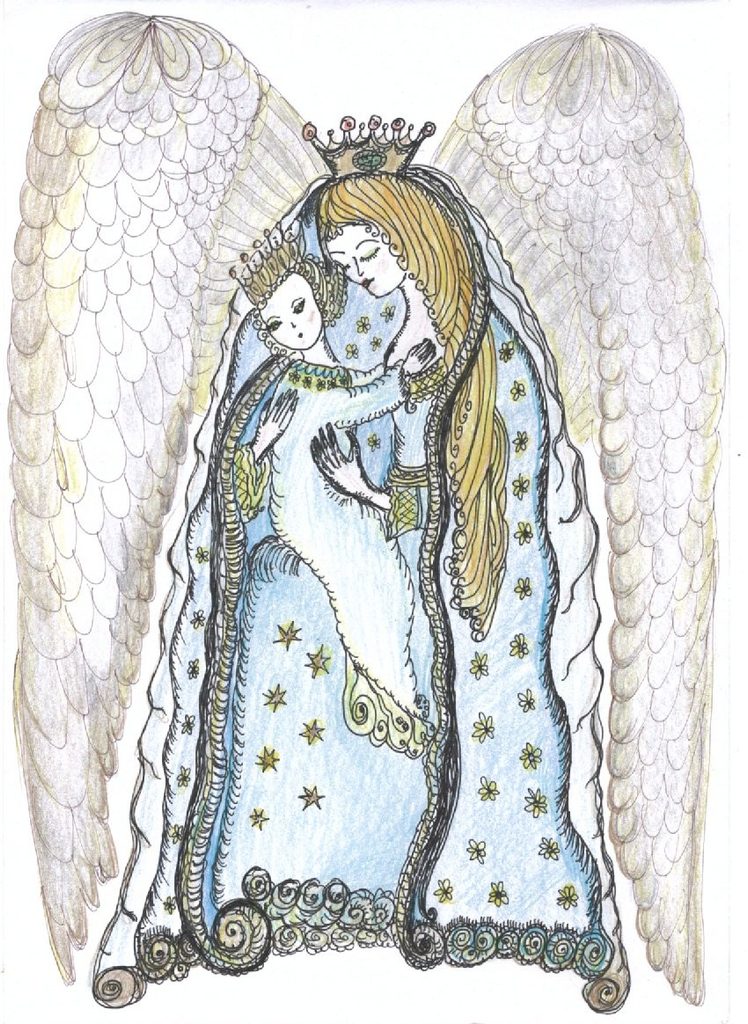
About 8 kilometers south of Zelená Hora in Žďár nad Sázavou lies Obyčtov, an ancient Marian pilgrimage site. The church, shaped like a turtle, is dedicated to the mystery of the Annunciation to the Virgin Mary.
The church was built posthumously based on a design by Jan Blažej Santini, known as Aichl, with the conceptual cooperation of Abbot Václav Vejmluva. When entering Obyčtov, you’ll notice a stone turtle on the left by the stream, a symbol of the village, and on the right, a chapel of Saint John of Nepomuk, reminding visitors of the nearby Zelená Hora.
On the promontory in front of you stands the church tower with a rounded Baroque dome, which blends nicely with the pleasant, rolling landscape around it. The first church dedicated to the Virgin Mary was built by the then lord of Obyčtov, Mikuláš Snilo, as early as the 13th century. He participated with his two grown sons in the Fifth Crusade to the Holy Land from 1217 to 1221, which was unsuccessful. Both sons died before his eyes.
He himself was injured but recovered and returned home. His wife told him that both sons appeared to her on the day of their deaths, shining with an extraordinary light, while she knelt and prayed before an image of Mary. In memory of their sons, they built a church in honor of the Virgin Mary, which was managed by priests of the Maltese Johannite Order. According to legend, since that time, not a single man from Obyčtov has died in any war.
The original church was repaired in 1672 and became a pilgrimage church dedicated to Mary. The abbot of the Cistercian monastery in Žďár, Václav Vejmluva, recognized the significance of the place and had a new church built on the site of the old one, one that would match the status of a Marian pilgrimage sanctuary. This architectural gem is slowly falling into oblivion.
The church is dedicated to the Feast of the Annunciation to the Virgin Mary, which in the Middle Ages was used as the start of the calendar year and was celebrated on March 25, exactly nine months before Christmas on December 25. It was built no later than 1730-1734, possibly by the builder František Wittinhofer. The sanctuary is shaped like a turtle, with a rectangular nave with chamfered corners representing the turtle’s body. The corner, square chapels are the legs, the shallow presbytery with clipped eastern corners is the neck, the polygonal sacristy is the head, and the western chapel with an antechamber is the turtle’s tail. The original spires are now missing from all the chapels. The turtle once symbolized steadfastness in faith; the Latin name ‘aestudo’ means not only turtle but also protection, in this case that of a Marian statue.
If you approach the temple along the road from the stream, it resembles a turtle basking on a rock, hidden behind centuries-old trees that protect the sacredness of the place. There are five monumental large-leaved lime trees, 35 meters tall, with trunk circumferences ranging from 290 to 520 centimeters. Their age is estimated at 250–300 years. The temple seems to guard the pilgrimage route to the north, toward Green Hill. And just as the shrine is dedicated to the mystery of the Annunciation to the Virgin Mary, to the north of it, Green Hill is dedicated to Saint John of Nepomuk, the guardian of the sacrament of confession.
The path between them is a pilgrimage path, our path through life, between birth and death, between heaven and earth. If you stand in the middle of the church, alone, watching the play of light and shadows, it’s as if you are curled up again inside your mother, protected and surrounded by her absolute love. In the same way, we will one day return to the womb of Mother Earth. The consecration of the church to the mystery of the Annunciation to the Virgin Mary, when the Archangel Gabriel announced to Mary that she would bear the Son of God, is a consecration to the mystery of life itself. The outer walls and roof of the church are like a turtle’s shell, protecting life with maternal love and symbolizing the invulnerability of this place. The essence of life and the beauty of nature give the place an unexpected significance; all you need to do is not rush, to stand, be silent, watch, and, just like the church, merge with the landscape.
Source: Parish Chronicle
Author: Edita Machová
Published in Czech: https://www.regionvysocina.cz/zpravodajstvi/santiniho-chram-v-obyctove/